AI for Small Businesses: Where It Really Helps and How to Start Safely
You don't need a big budget or a data team to benefit from AI. You need a clear task, a small pilot and human review in the right place.
Talk about AI for small business swings between two exaggerations: "it will replace every employee" and "it's just hype". The practical reality is simpler: generative AI tools are excellent at some tasks, weak at others, and always need a person in charge of decisions. This guide shows where AI really helps, where to be careful and how to start with a small, safe pilot.
Key takeaways
- 1AI speeds up the first draft; people own accuracy and decisions.
- 2Start with repetitive, low-risk tasks: drafts, summaries and sorting messages.
- 3Don't put sensitive data into a tool whose data policy you don't know, and verify every figure before publishing.
- 4Pilot one task for two weeks, measure time and quality, then decide to scale or stop.
How do AI and people share the work?
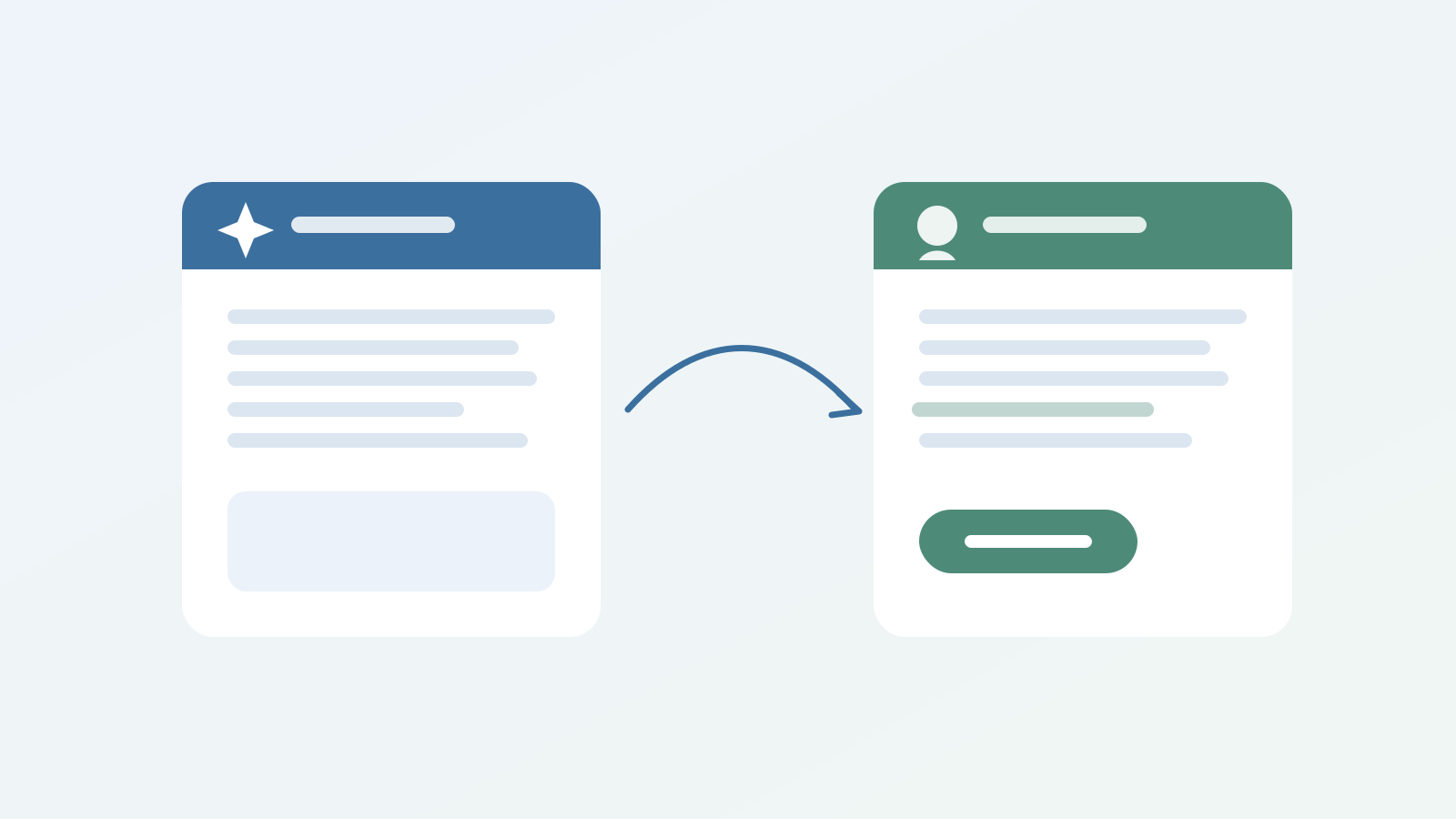
The most successful uses aren't "give the task to the machine" but a clear split of roles: the machine speeds up what's repetitive, and people add the expertise and accountability it doesn't have. Here's what that looks like when answering a customer enquiry:
Splitting the work on a customer enquiry
- 1Sorts the message
Price question, complaint or support request
- 2Drafts the reply
From your approved website pages and policies
- 3Checks the facts
Prices, dates and promises must be correct
- 4Adds the personal touch
Knowledge of the customer and the brand's voice
- 5Suggests a follow-up
A reminder a few days later if the customer doesn't reply
- 6Approves and sends
Final responsibility stays with a person
Where does AI for small business really help?
Emails, product descriptions and posts. The draft comes from the machine; checking and tone come from a person. Try the AI Content Assistant.
An assistant that answers recurring questions from your site's content and hands complex cases to your team. See our chatbot guide.
Meeting notes, key points from long contracts and turning scattered notes into tasks.
Sorting hundreds of reviews by topic and sentiment so you read the summary and check the examples.
Where should you be careful?
Not every use carries the same risk. This practical grouping helps you start in the safe zone:
Start here
- Drafting content and emails
- Summarising meetings and documents
- Sorting support messages
- Ideas for headlines and posts
Needs careful review
- Any facts or figures that will be published
- Replies that include prices or commitments
- Feedback analysis before a decision
- Legal or financial wording
Keep it with people
- Decisions about people, such as hiring
- Sensitive personal data
- Legal and medical advice
- Full reliance with no fallback
The most important rule at every level:
Two examples of what can happen without review
The confident wrong answer. An employee asked an AI tool to draft a reply to a customer asking about the returns policy, and the tool wrote a polite answer mentioning "a 30-day window", while the store's actual policy is fourteen days. The tool doesn't know your policy unless you give it, but it writes as confidently as if it did. The fix is to include the official policy text in every request and to have a person review any reply that contains a financial or legal commitment.
Data that left without anyone noticing. Pasting a whole spreadsheet of customer names and phone numbers into a free tool to summarise it may mean that data is now outside your control. Before adopting any tool, read its privacy settings, use business plans that keep your data out of training, and strip personal information before pasting. The NIST AI Risk Management Framework is a useful reference if you want a structured way to think about these risks.
A safe four-week start
Don't start with a big project. Start with a short pilot cycle measured in numbers:
- 1Pick a task
One repetitive, well-defined task, such as first replies to pricing enquiries.
- 2Set the measure
Time taken, share of replies needing major edits, and customer satisfaction.
- 3Pilot for two weeks
With one owner, documenting the prompts that work so they become the team standard.
- 4Decide with data
Scale the pilot, adjust it or stop it.
Results improve a lot with how the instructions are written; learn it in our prompt writing guide.
A prompt library: the smallest step with the biggest effect
During the pilot weeks, ask everyone using the tool to save prompts that produced good results in one shared file, with an example output and a note on what needed editing. After a month you'll have a prompt library of your own: a prompt for replying to a price enquiry, one for summarising the weekly meeting, one for writing a product description in your brand's voice. The library shortens onboarding for new staff, keeps quality consistent across the team and stops the same mistakes repeating. Review it monthly, remove what no longer helps, and add the standing context the tool needs every time, such as descriptions of your services and your official policies.
How to choose the right tool
| Question | Why it matters |
|---|---|
| Is your data used for training? | Decides what you can safely put into it |
| Does it connect to your systems (email, CRM, website)? | An isolated tool adds copy-and-paste instead of saving time |
| What's the real cost as you scale? | Usage-based pricing can multiply as the team grows |
| Does it handle your customers' language well? | Test it on real customer texts, not generic examples |
A simple payback calculation before you subscribe
Don't subscribe to a tool because it's popular; do the maths first. Suppose your customer service employee spends ten hours a week writing similar replies, and a pilot shows the tool cuts that time in half once review is included. That's five hours a week, or roughly twenty hours a month. Compare the value of those hours with the monthly subscription, and add setup and training time in the first month.
If the hours saved are few, or review eats most of them, the tool isn't worth it yet, however impressive the demo. If the saving is clear, start with one or two seats and only expand once the success repeats on a second task.
A worked example: a store receiving dozens of messages a day
A small online store gets many messages about order status and returns. The start: a clear FAQ page, then an assistant that answers from it and hands special cases to a staff member. The store measures how many messages were resolved without help, the hand-off rate and customer ratings, and decides after a month based on numbers, not impressions.
Common mistakes when adopting AI for small business
Starting with the hardest task. Some businesses begin by automating customer service entirely with a chatbot and end up making mistakes in front of customers. Start with low-risk internal tasks such as summarising meetings or writing first drafts, then move to customer-facing work once the team has experience.
Not writing down usage rules. Even a small team needs one page that says which tools are allowed, which data must never be entered and who reviews what before it's published or sent. We explain how to write it in our AI governance guide for small businesses.
Vague prompts. "Write a post about our services" produces generic text that doesn't sound like you. Give the tool context, audience, tone and an example of what you want, as explained in our prompt engineering guide for business.
Forgetting to measure quality. Saving time is worthless if errors increase. Each week, review a small sample of outputs and note how many needed substantial edits.
How do you measure the impact of AI in a small business?
Pick three simple measures for every task you pilot: time spent on it before and after, quality (the share of outputs accepted without major edits) and customer impact (response speed or satisfaction). Record them in a simple table weekly for a month. If time improves without quality dropping, the pilot worked and you can make it standard and train the rest of the team. If you want to start with a concrete task today, try the AI content assistant to draft a description of one of your services, then compare the time you needed to review it with the time it used to take to write from scratch. That is the realistic way to use AI for small business: small experiments, honest measurement and a person in charge.
A quick assessment before adopting any AI tool
Before relying on a tool for daily work, answer these six questions in a shared document:
- What exactly is the task? "Drafting replies to pricing inquiries" is far clearer than "AI customer service".
- What data will go into the tool? Customer names, special prices or contracts? If so, review its privacy and retention policy first.
- Who reviews the output? Name an owner and the level of review each type of content needs.
- How will we measure the benefit? Hours saved per week and errors caught in review.
- What's the fallback? How do we get the work done if the service stops or its pricing changes?
- Do we tell customers? For automated content or conversations, transparency builds trust.
This simple template turns enthusiasm for technology into a considered decision, and prevents depending on a tool before understanding its impact and risks.
Conclusion
In a small business, AI is a fast assistant, not a substitute for expertise. Split roles clearly, start with a low-risk task, protect your data, measure honestly and keep people in charge of decisions. If you'd like AI solutions connected to your systems and content, explore our AI solutions service.
Frequently asked questions
Will AI replace employees in small businesses?
In practice it shortens repetitive tasks such as drafting, summarising and first replies, while judgment, expertise and customer relationships stay with people.
Can I put customer data into AI tools?
Only in tools whose data retention policy you know and that don't train on your data, and only the minimum needed. Better still, remove personal details first.
Where do I start with no experience?
Pick one repetitive task such as drafting replies to enquiries, pilot it for two weeks with one owner, and measure time and quality before expanding.
Can I paste customer data into AI tools?
Avoid it unless the tool is a business plan whose policy says your data isn't used for training and is stored securely. Remove names, numbers and addresses before pasting any text, and know what your country's data protection rules require.
How do I know whether an AI pilot worked?
Before you start, choose one number to measure, such as time spent replying to messages or how many drafts need rewriting. Compare it before the pilot and after four weeks, and review a sample of outputs to make sure quality didn't drop.
Sources & references

I believe technology is useful when it solves a clear problem — not when it's adopted because it's trendy. AI is a powerful tool for speeding up research, writing, analysis and automation, but it needs human expertise to review, guide and verify accuracy. That's why I prefer to start by understanding the business and its goals, then choose the simplest solution that delivers a measurable result, and build audience trust with honest, useful content.
- Reader rating
- 5.0(2)
- Published articles
- 82
- #ai
- #small business
- #productivity
How would you rate this article?
Be the first to rate
Comments
No comments yet. Share your thoughts!