An AI Usage Policy for Small Businesses: Clear Rules That Protect Data and Speed Up Work
Your team uses AI tools whether or not you write a policy. A clear policy doesn't stop them; it sets where they can use them safely and where to stop.
Your team is using AI tools today, whether or not you've written rules for it: one person summarises a contract, another drafts a customer reply, a third analyses a sales sheet. The problem isn't the use; it's that someone may enter customer data or business secrets into a tool without knowing where that data goes. Good AI governance for a small business doesn't need a committee. A short, clear AI usage policy solves the problem: it doesn't stop the team, it sets where they can move ahead confidently and where to stop.
Key takeaways
- 1A good policy is a page or two, not a handbook nobody reads.
- 2Split uses into allowed, needs care and forbidden.
- 3Classify your data and state what is never entered into any tool.
- 4Approve a list of trusted tools, and make human review mandatory for anything published.
AI governance made simple: a traffic-light policy
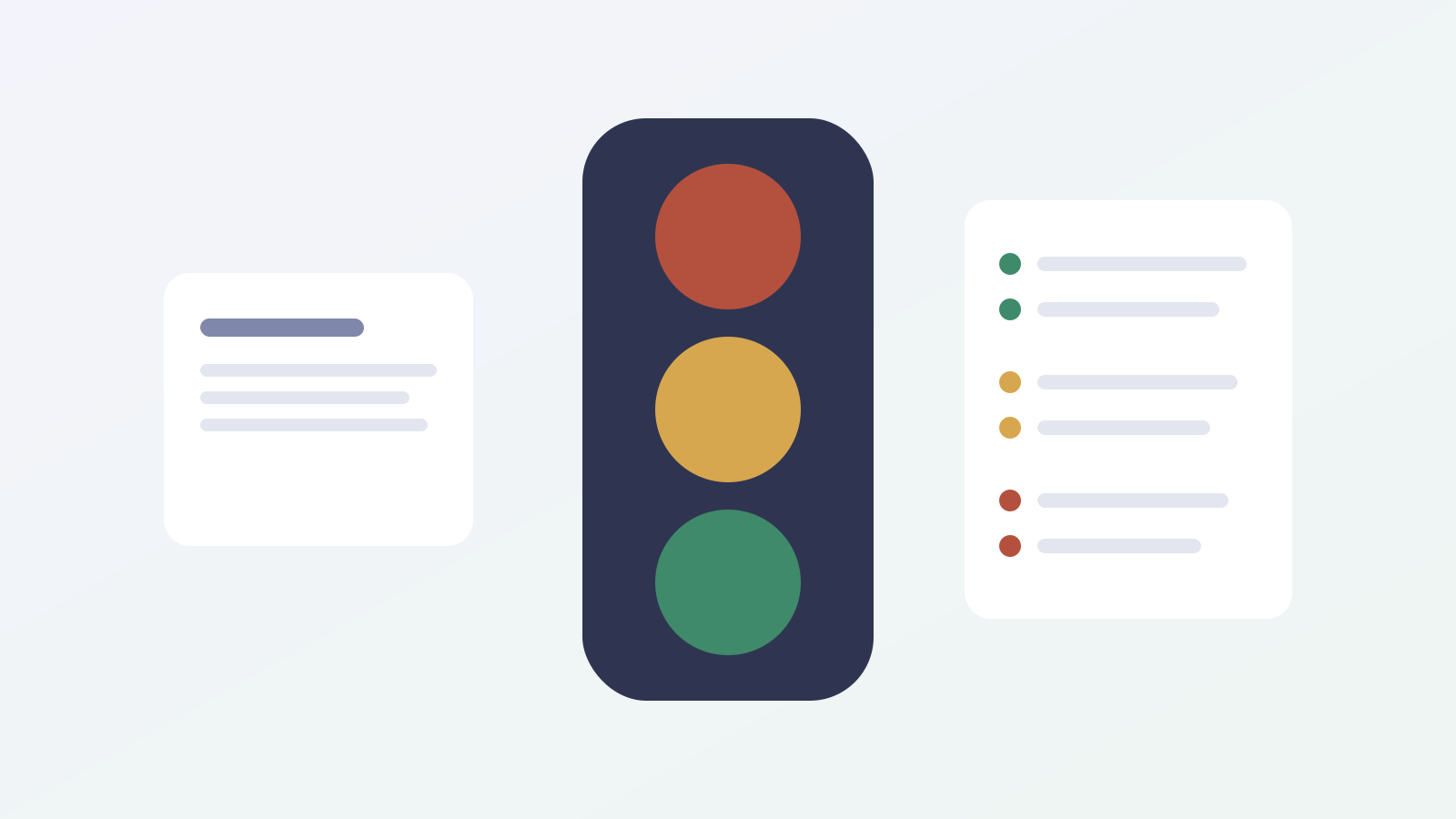
The easiest way for a team to remember the rules is to split them into three colours. Everyone instantly knows where their use falls:
An AI policy as a traffic light
Allowed
- Drafting content and general emails
- Summarising non-confidential documents
- Ideas, headlines and rewording
- First-pass translation of public text
Needs care and review
- Any figures or facts that will be published
- Customer replies before they're sent
- Data analysis after removing personal details
- Code before using it in production
Forbidden
- Entering customers' personal data
- Contracts and confidential financial information
- Passwords and system keys
- Decisions affecting people without a human
1. Classify your data
The heart of the policy is one question: what may be entered into which tool?
| Data class | Examples | In AI tools |
|---|---|---|
| Public | Published website content and marketing copy | Allowed in approved tools |
| Internal | Work procedures and unpublished drafts | Only in tools with a clear data policy |
| Confidential | Customer data, contracts and financial figures | Forbidden, except in a dedicated system with approved controls |
An illustrative example: three categories cover most businesses
Public data: anything already published, such as service descriptions on your site, articles and advertised package prices. It can be used in any approved tool.
Internal data: marketing plans, draft proposals and internal correspondence. Only to be used in approved tools with business accounts that don't train on your inputs.
Sensitive data: customers' personal details, account numbers, contracts, salaries and passwords. Never entered into any general-purpose AI tool; if someone needs to describe a situation, they replace it with made-up placeholders.
Once people know the category, they know the rule without having to ask someone every time.
2. Approve a list of trusted tools
- 1Review the data policy
Are your inputs used for training? Where are they stored, and for how long?
- 2Prefer business accounts
Business plans usually offer clearer data controls.
- 3Assign an owner to each tool
Someone who follows updates, settings and permissions.
- 4Share the list with the team
Approved tools are clear, and any new tool is reviewed first.
What to ask before approving a tool
Ask four questions about each tool: where is the data we enter stored? Is it used to train models, and can that be switched off? Who in the business owns the account and can remove access when someone leaves? Is there a business version with clearer data terms? The answers are usually on the privacy or terms page, and reading them once saves a lot of trouble later.
For a broader framework, the US National Institute of Standards and Technology publishes the free AI Risk Management Framework, from which a small business can take whatever suits its size. You don't need all of it for effective AI governance, but it's a useful reference as you grow.
3. Human review and transparency
Every piece of content or customer reply passes a person before going out.
Models can invent convincing information; check every number and source.
Tell them when they're talking to an assistant, as in our chatbot guide.
But none of this is enough on its own:
State plainly in the policy who is accountable: the person who publishes or sends a piece of content is responsible for it, whether they wrote it alone or with a tool. That one sentence turns review into a habit rather than an optional step.
4. Train the team to use AI well
The policy sets the boundaries; training raises the value within them: how to write clear prompts, as in our prompt writing guide, where the tools really help, as in our AI for small business guide, and how to handle mistakes.
Keep the policy to one page
A twenty-page policy nobody reads protects nothing. Write a one-page version with the traffic light, the data categories, the list of approved tools and the name of the person to ask when in doubt, and put it where everyone can see it. Review it every six months, or whenever you adopt a new tool, because tools and their terms change quickly. Practical AI governance is a short document people actually follow, updated as you learn.
Common AI governance mistakes
Banning everything. When a business bans all tools, people often use them from personal accounts with no safeguards at all. A clear policy that allows safe use beats a ban nobody follows.
A written policy nobody knows about. A document saved in a folder nobody opens protects nothing. Explain it in a short meeting and go over it with every new starter.
Vague wording. "Use tools responsibly" tells people nothing. Write specific examples of what's allowed and what isn't, in the language of your day-to-day work.
Forgetting accounts when people leave. A tool account in a former employee's name may still hold a chat history full of business information. Make removing access part of your leaving process.
Treating governance as a one-off project. New tools arrive every month and existing ones change their terms. Put a date in the calendar to review the policy, so AI governance keeps pace with how your team actually works.
Common scenarios and how to handle them
An employee wants to summarise a client contract: not allowed in a public tool. Use an approved tool with a contract guaranteeing your data isn't used for training, or summarise only the non-sensitive sections by hand.
Marketing wants AI-generated product images: fine for ideas and drafts, provided commercial-use terms allow it and customers aren't misled into thinking they're real product photos.
A chatbot on the website: allowed, provided it discloses that it's an automated assistant, answers only from company content and offers a clear way to reach a person.
Using a new tool that isn't approved yet: send the owner a request with the tool's link and purpose, and decide within a few days so work isn't blocked.
Walking through these scenarios with the team makes the policy practical and understood rather than a list of abstract rules. Add new scenarios to the list as they come up, so the policy grows with real experience.
Conclusion
An AI usage policy doesn't slow your team down; it gives them confidence: a clear traffic light for uses, data classification that states what is never entered, an approved tool list, human review of everything published, and training with regular review. If you'd like to build safe AI solutions for your company, explore our AI solutions service.
Frequently asked questions
Why does a small business need an AI policy?
Because staff already use the tools and may enter customer data or secrets unintentionally. A short, clear policy protects data and gives the team confidence to use them.
What's the most important clause?
Data classification: what may be entered into which tool, and what is never entered, such as customers' personal data, financial information and trade secrets.
How often should we review the policy?
Roughly every six months, or whenever you adopt a new tool, because tools and their policies change quickly.
Who should write the AI policy in a small business?
Usually the owner or manager, together with someone who understands the tools in use, then shared with the team before it's adopted. Staff feedback matters because they know where the tools are actually used. If the business handles sensitive data, a short legal consultation is worth the cost.
What do we do if someone enters sensitive data into an unapproved tool?
Handle it calmly and quickly: find out what data was entered, delete the conversation or account if possible, check the tool's settings and data policy, and notify anyone who needs to know if customer data was involved. Then turn the incident into a lesson for the team, and update the policy if it revealed a gap.
Sources & references

I believe technology is useful when it solves a clear problem — not when it's adopted because it's trendy. AI is a powerful tool for speeding up research, writing, analysis and automation, but it needs human expertise to review, guide and verify accuracy. That's why I prefer to start by understanding the business and its goals, then choose the simplest solution that delivers a measurable result, and build audience trust with honest, useful content.
- Reader rating
- 5.0(2)
- Published articles
- 82
- #ai governance
- #policy
- #risk
How would you rate this article?
Be the first to rate
Comments
No comments yet. Share your thoughts!