AI Chatbots for Customer Service: Building an Assistant That Answers Accurately and Knows When to Hand Off
A good chatbot doesn't pretend to know everything. It answers from your approved sources, admits when it doesn't know, and hands customers to staff without making them repeat themselves.
A customer asks at midnight: "Can I return the product a week after delivery?" Either they wait until morning, or an assistant answers instantly. AI chatbots for customer service answer recurring questions around the clock, but the gap between an assistant customers love and one that annoys them is huge: the first answers from trusted sources and knows its limits; the second invents answers or loops endlessly.
Key takeaways
- 1A good chatbot answers only from your approved content, not its "general knowledge".
- 2Admitting it doesn't know and handing off to staff is a feature, not a weakness.
- 3On hand-off, staff receive the conversation context so customers don't repeat themselves.
- 4Measure the share resolved without help and customer satisfaction, not conversation counts alone.
What does a good conversation look like?
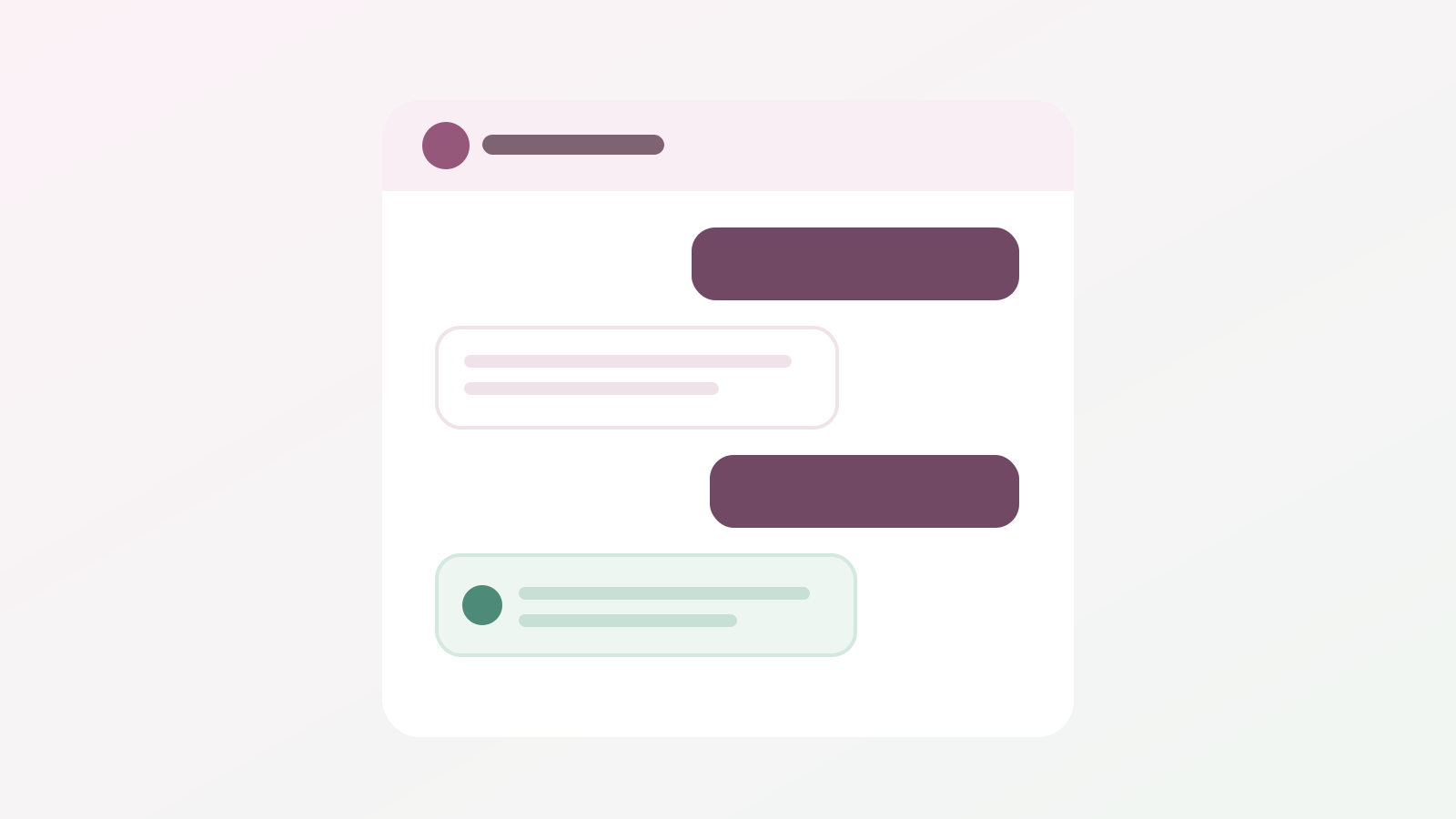
Here's an example where the assistant and a staff member share the work: the assistant answers the recurring question from the store's policy and hands the special case to a person without wasting the customer's time:
An assistant that answers, then knows when to hand off
- CustomerCan I return my order a week after receiving it?
- AssistantYes, returns are accepted within 14 days of delivery if the product is in its original condition, according to the store's returns policy.
- CustomerThe product arrived damaged and I need a replacement quickly.
- AssistantI'm sorry about that. I'm passing you to a customer service agent now, with your order details, so you won't need to explain again.
- Support agentHello, I've seen your order and the photo. We'll send the replacement today and collect the damaged item from your address.
1. Answer from your sources, not the model's imagination
Language models can write convincing answers even when they're wrong. The fix is for the assistant to answer only from your approved content: FAQ pages, policies and product guides. This approach is called retrieval-augmented generation (RAG), which we explain in detail in our RAG guide.
An assistant answering from "general knowledge"
- Guesses policies and prices
- Gives outdated answers, or another company's
- Never admits it doesn't know
An assistant answering from your sources
- Quotes your approved policies and pages
- Updates automatically when content changes
- Says "I don't know" and hands off to staff
How do you prepare the knowledge base the assistant answers from?
Start with the fifty questions your team receives most, gathered from messages, calls and email. For each, write a short, clear official answer with its conditions and exceptions: "Products can be returned within 14 days of delivery if in original condition, except custom-made items." A vague answer in the source produces a vague answer from the assistant, and this exercise often reveals that the team itself was answering the same question in different ways.
Put these answers on real pages of your site, such as the FAQ, the returns policy and service pages, then have the assistant rely on them. The same content then works twice: visitors and search engines read it directly, and AI chatbots answer from it. When a policy changes, you update the page and the assistant's answers change with it. We explain the technical idea behind this in our guide to RAG and language models.
2. Handing off to staff: when and how?
An upset customer needs a person who understands, not repeated automated replies.
Cases involving a customer's data or money need human verification.
Admitting it and handing off beats an invented answer.
If customers ask for a person, don't argue.
A good hand-off passes a summary of the conversation to staff, so the customer doesn't start from scratch.
Example: a conversation handed off at the right moment
A customer writes: "My order arrived missing a part, and this is the second time!" A poor assistant replies with generic text about the returns policy. A good one picks up three signals: a problem with an existing order, a repeat, and clear frustration. It apologises in one short sentence, asks for the order number and a photo if possible, then says: "I'm transferring you now to my colleague on the orders team with all the details, so you won't need to repeat them," and passes the full conversation to her.
The customer never felt trapped with a machine and didn't have to retell the story. Define the handoff rules in advance: complaints, money matters, requests that need an exception, and any time a customer asks to speak to a person. And tell the customer honestly when a person will reply if it's outside working hours.
3. Tone, dialect and privacy
- 1Define the assistant's personality
Polite, concise and in your brand's voice, without overdoing warmth or formality.
- 2Choose the reply language and dialect
Plain formal language or your audience's dialect, tested on real messages.
- 3Don't ask for unnecessary data
And don't store sensitive information without need and a clear policy.
- 4Tell customers they're talking to an assistant
Clarity builds trust, and they can ask for a person at any time.
And before any of this, one step you can't skip:
On privacy specifically, don't ask for data you don't need in the chat, and never let the assistant reveal account details without verifying the customer's identity. Tell visitors at the start that they're talking to an automated assistant, and where conversations are stored and for how long. The NIST AI Risk Management Framework stresses transparency and accountability as foundations of trustworthy AI, and that's what your customers expect from AI chatbots too.
4. Measure what matters for AI chatbots
| Metric | What it tells you |
|---|---|
| Resolution without help | How many questions closed without needing staff |
| Hand-off rate | A high rate may mean gaps in your approved content |
| Post-chat satisfaction | Was the experience genuinely helpful? |
| Unanswered questions | A ready list of new FAQ content to write |
Common mistakes when launching AI chatbots
Launching to every customer on day one. Start with one page or channel, or out-of-hours only, and review conversations daily for the first two weeks. You'll find questions you didn't expect and answers that need fixing before everyone sees them.
Hiding the route to a human. An assistant that loops customers without a "talk to an agent" option turns a simple question into an angry complaint.
An assistant promising what it can't. A discount, a delivery date, an exception to policy: if the assistant says it, your company has committed to it in front of the customer. Block it from making any financial or exceptional commitment, and keep those decisions with staff.
Letting content go stale. Prices or opening hours changed but the sources weren't updated, so the assistant starts giving outdated answers. Make updating the knowledge base part of every service change.
A six-week launch plan
Weeks one and two: gather recurring questions, write official answers and publish them on your site. Week three: set the assistant up on those sources, define handoff rules and tone, and test it internally with real, difficult and provocative questions. Week four: launch on one channel and review every conversation daily. Weeks five and six: measure the resolution rate without staff, the handoff rate and customer satisfaction, and add missing answers. You can try the AI assistant tool on our site to see how answering from defined content works, and read about limits and oversight in our AI governance guide. AI chatbots succeed in customer service when they extend your team and its knowledge, not when they speak for it without oversight.
A worked example: the first 30 days of a chatbot at a services company
Week one — content: collect the 30 most frequent questions from email, phone and chat, and write a short, precise answer to each on your FAQ page, linking to the page with the details.
Week two — setup: connect the bot to your site content, write a welcome message explaining what it can do, and decide when it should suggest a human: when a complaint or refund is mentioned, or after two questions without a clear answer.
Week three — limited launch: enable it on support pages only and review every conversation daily. Sort unanswered questions into missing content, unclear phrasing, or requests that need a person.
Week four — improve: add the missing answers to the site, roll the bot out to the remaining pages, and set monthly metrics: resolution without handoff, team response time for handed-off cases, and user ratings.
This gradual approach surfaces problems early, and the content itself improves for every visitor — including those who never open the chat.
Conclusion
A successful chatbot answers from your approved sources, knows its limits, hands off to staff at the right moment with the conversation's context, speaks in your brand's voice and is measured by customer satisfaction, not conversation counts. Start with the most frequent questions, then expand. For broader uses, read our AI agents guide, or explore our AI solutions service.
Frequently asked questions
How do I stop the chatbot inventing answers?
Make it answer only from your approved content using retrieval (RAG), instruct it to admit when it can't find an answer and hand off, and review conversations regularly.
When should it hand off to a person?
For complaints and strong emotions, account- or payment-specific cases, when it can't find a reliable answer, or whenever the customer asks for a person.
Can a chatbot understand Arabic dialects?
Modern models generally handle common dialects well, but test on real customer messages before launch and set the reply dialect that suits your audience.
Does a chatbot replace the customer service team?
No. Its role is to answer clear, recurring questions instantly and gather request details before handing off, freeing the team for cases that need judgement, empathy or authority. Companies that try to remove staff entirely usually lose customer satisfaction in the difficult cases.
Where does the bot learn my company's answers?
From content you provide: FAQ pages, policies, service and pricing descriptions, and approved team replies. The clearer and more current that content, the more accurate the answers, and when the answer isn't there, the bot should say so and hand the conversation over.
Sources & references

I believe technology is useful when it solves a clear problem — not when it's adopted because it's trendy. AI is a powerful tool for speeding up research, writing, analysis and automation, but it needs human expertise to review, guide and verify accuracy. That's why I prefer to start by understanding the business and its goals, then choose the simplest solution that delivers a measurable result, and build audience trust with honest, useful content.
- Reader rating
- 5.0(2)
- Published articles
- 81
- #chatbot
- #customer service
- #ai
How would you rate this article?
Be the first to rate
Comments
No comments yet. Share your thoughts!