RAG Explained Simply: Making AI Answer Accurately From Your Company's Documents
A language model doesn't know your company's policies or prices. RAG makes it search your documents first, then answer from them with the source cited.
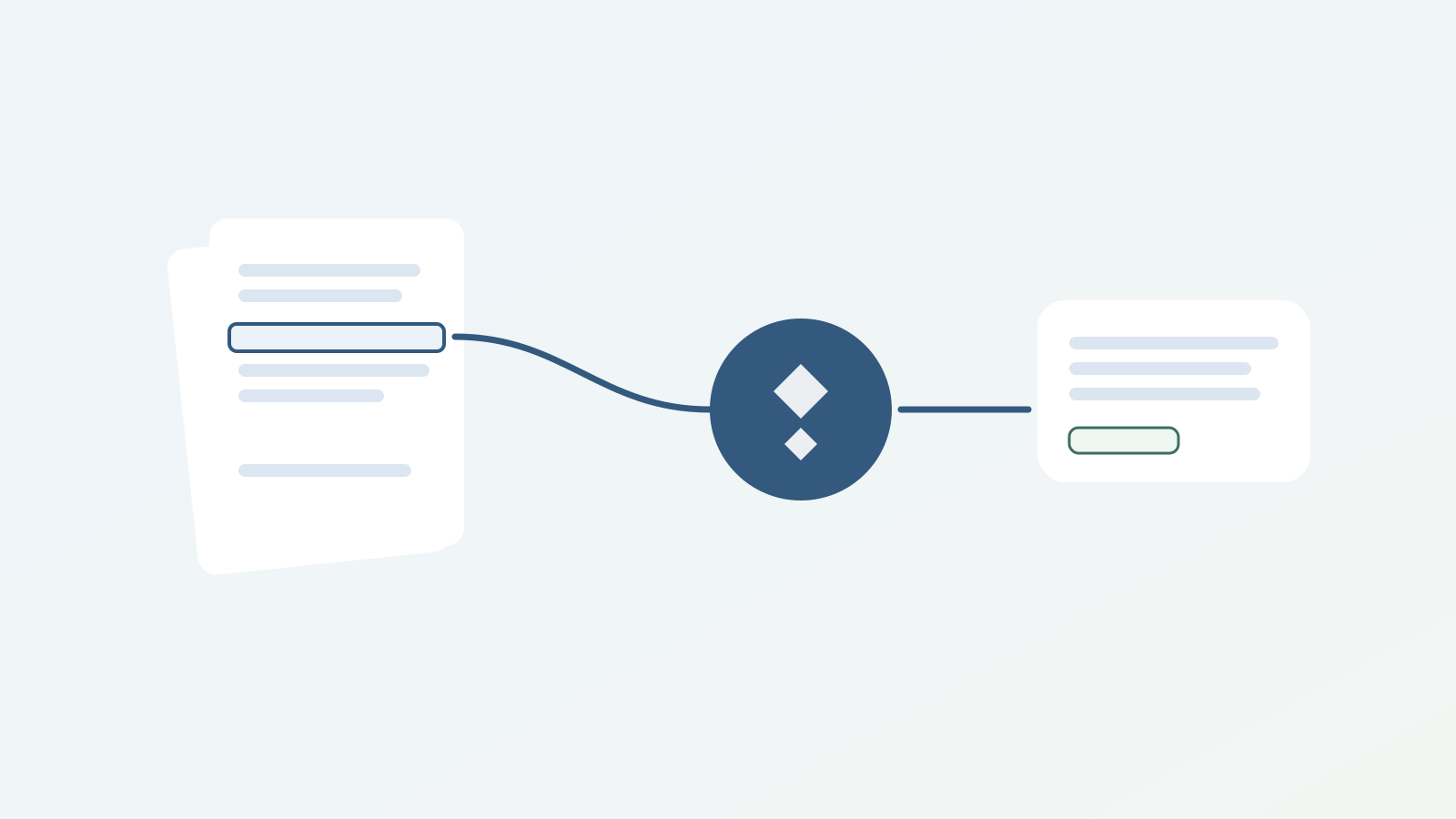
Ask a general language model about your store's returns policy and it will answer confidently, but its answer will be a guess, because it has never read your policy. RAG, or retrieval-augmented generation, is the most widely used fix for this problem: before the model answers, the system searches your documents for the right passages, then answers from them with the source cited.
Key takeaways
- 1RAG combines searching your documents with language generation in one answer.
- 2The model answers from retrieved passages, not its "general memory", so errors drop.
- 3Updating a document updates the answers instantly, with no retraining.
- 4System quality depends on document and retrieval quality, and needs regular testing.
How does RAG work, step by step?
The system has two phases: preparing the documents once, then answering each question. Here's a question's journey from the moment it's typed to the answer:
A question's journey through a RAG system
- The customer types a question
"Can I return the product after a week?"
- Searching the documents
The question is turned into a numeric representation and compared with your indexed passages
- Retrieving the closest passages
For example, the paragraph on the return window in the store policy
- Generating the answer
The model answers from the retrieved passages only, in natural language
- Citing the source
The answer points to the document it came from, for verification
- No suitable passages
The system admits it doesn't know and hands off to staff
The idea first appeared in a 2020 research paper, Retrieval-Augmented Generation for Knowledge-Intensive NLP Tasks, and has since become the most common way to connect language models to company data.
Why are documents split into chunks?
The model doesn't read all your documents for every question; that would be slow and expensive. So documents are split in advance into small chunks, a paragraph or two each, and each chunk is stored with a numerical representation of its meaning. When a question arrives, it's converted the same way, and the system looks for the chunks closest to it in meaning, not just in wording. That's why it can find a paragraph about "returning products" even when a customer asks about "exchanging my order".
Chunk size is an important decision: chunks that are too small lose context, and chunks that are too large mix different topics. Teams usually test several sizes against real questions to find what suits their kind of documents.
Why RAG and not just a general model?
A general model without retrieval
- Answers from general knowledge and may guess
- Doesn't know your policies, prices or updates
- Cites no source you can check
A model with RAG
- Answers from your approved documents
- Updates as soon as a document changes
- Points to the source of every answer
Practical business uses
An assistant answering from policies and FAQs, as in our chatbot guide.
Natural-language search across staff handbooks and procedures.
Accurate answers from the product catalogue and specifications.
Summarising contracts and reports with pointers to the relevant sections.
An illustrative example: an internal assistant for a sales team
Imagine a company whose product manuals, price lists and warranty terms are spread across dozens of files. A new salesperson spends a lot of time asking colleagues about simple details. With a RAG system, they type: "How long is the warranty on the newest model, and does it cover installation?" and get a short answer with the name of the file and the passage it came from. They can open the source and check before replying to the customer, and that's the difference between an assistant you can trust and one that guesses.
What determines a RAG system's quality?
- 1Clean, up-to-date documents
An outdated or conflicting document means an outdated or conflicting answer.
- 2Thoughtful chunking
Passages sized to keep meaning intact, neither whole pages nor broken sentences.
- 3Accurate retrieval
The system really finding the right passage, tested on real questions.
- 4Strict model instructions
Answer from the passages only, cite the source and admit when you don't know.
Even so, there's one limit you need to know:
How to test the system before launch
Write fifty real questions collected from your support or sales team, each with the correct answer and the document it comes from. Put them to the system and record two things for each: did it retrieve the right passage, and was the answer correct and based on that passage? Keeping the two apart matters, because a wrong answer may come from poor retrieval rather than a weak model, and each needs a different fix.
Include questions whose answers aren't in your documents at all. A good system says "I can't find this information in the available sources" instead of inventing an answer. Run the same test set again after every significant change, so you can see whether quality went up or down.
Common mistakes when building a RAG system
Loading every file without cleaning. Old versions of the same policy and drafts that were never approved make the system answer with conflicting information. Start with a small set of approved documents, then expand.
Forgetting to update the sources. When prices or policies change and the system isn't updated, it will keep answering with the old information, and with complete confidence. Decide who updates the documents and when.
Hiding sources from users. An answer without a source can't be checked. Always show the document name or link alongside the answer.
Ignoring permissions. If some documents belong to management or HR, the system must not retrieve them for people who aren't allowed to see them. Design permissions from the start, not after launch.
Expecting retrieval to fix poor writing. If the original documents are vague or contradictory, the answers will be too. Clear, well-structured source documents remain the single biggest factor in how useful the system turns out to be.
An example: an assistant for an online store
Imagine a store that gets questions about shipping, returns and sizes. Steps to build a simple RAG assistant:
- Gather sources: shipping and returns pages, the FAQ and size charts.
- Clean up: remove outdated information and reconcile conflicts — the system can't tell current from stale.
- Chunk: each question-and-answer pair is its own chunk, as is each section of the policy.
- Test: forty real questions from customer messages, with their correct answers.
- Limited launch: on the support page only, with a clear button to reach a person.
After launch, review the questions the system couldn't answer. They reveal content missing from the site itself, and adding it helps every visitor — not just the assistant. Re-run your forty test questions after each content change to make sure nothing that worked before has broken.
Conclusion
RAG makes AI answer from your company's documents instead of guessing: it retrieves the right passages, generates an answer from them, cites the source and admits when it finds nothing. Its quality starts with your documents and is kept up through continuous testing. For the next step towards systems that complete whole tasks, read our AI agents guide, or explore our AI solutions service.
Frequently asked questions
How is RAG different from training the model on my data?
RAG doesn't change the model; it supplies relevant passages from your documents with each question, so content can be updated instantly. Training changes the model itself and is costlier and harder to update.
Does RAG stop wrong answers entirely?
It reduces them a lot but doesn't eliminate them. Answer quality depends on document and retrieval quality, so require cited sources and test on real questions.
What are business examples of RAG?
A customer service assistant answering from policies, internal search across staff handbooks, a sales assistant answering from the product catalogue, and summarising long contracts.
What documents make a good source for a RAG system?
Any structured, reliable text: company policies, product manuals, FAQs, standard service agreements and records of decisions. Above all they must be current and consistent, because the system will answer from them as they are. Clean out old and duplicate documents before adding them.
Do my documents stay private when I use RAG?
That depends on how it's built and on the provider. A system can be designed so documents stay on your own servers and only the passage needed for each question is sent to the model. Ask the provider plainly: where are documents stored, who can access them and are they used to train models?
Sources & references

I believe technology is useful when it solves a clear problem — not when it's adopted because it's trendy. AI is a powerful tool for speeding up research, writing, analysis and automation, but it needs human expertise to review, guide and verify accuracy. That's why I prefer to start by understanding the business and its goals, then choose the simplest solution that delivers a measurable result, and build audience trust with honest, useful content.
- Reader rating
- 5.0(2)
- Published articles
- 82
- #rag
- #llm
- #knowledge base
How would you rate this article?
5.0 / 5 · 1 rating
Comments
No comments yet. Share your thoughts!