Unit Conversion Guide: Length, Weight, Area, Temperature and Storage Without Mistakes
Unit conversions are everywhere: a screen size, a shipment's weight, a plot of land, a temperature. Knowing the exact conversions protects you from costly mistakes.
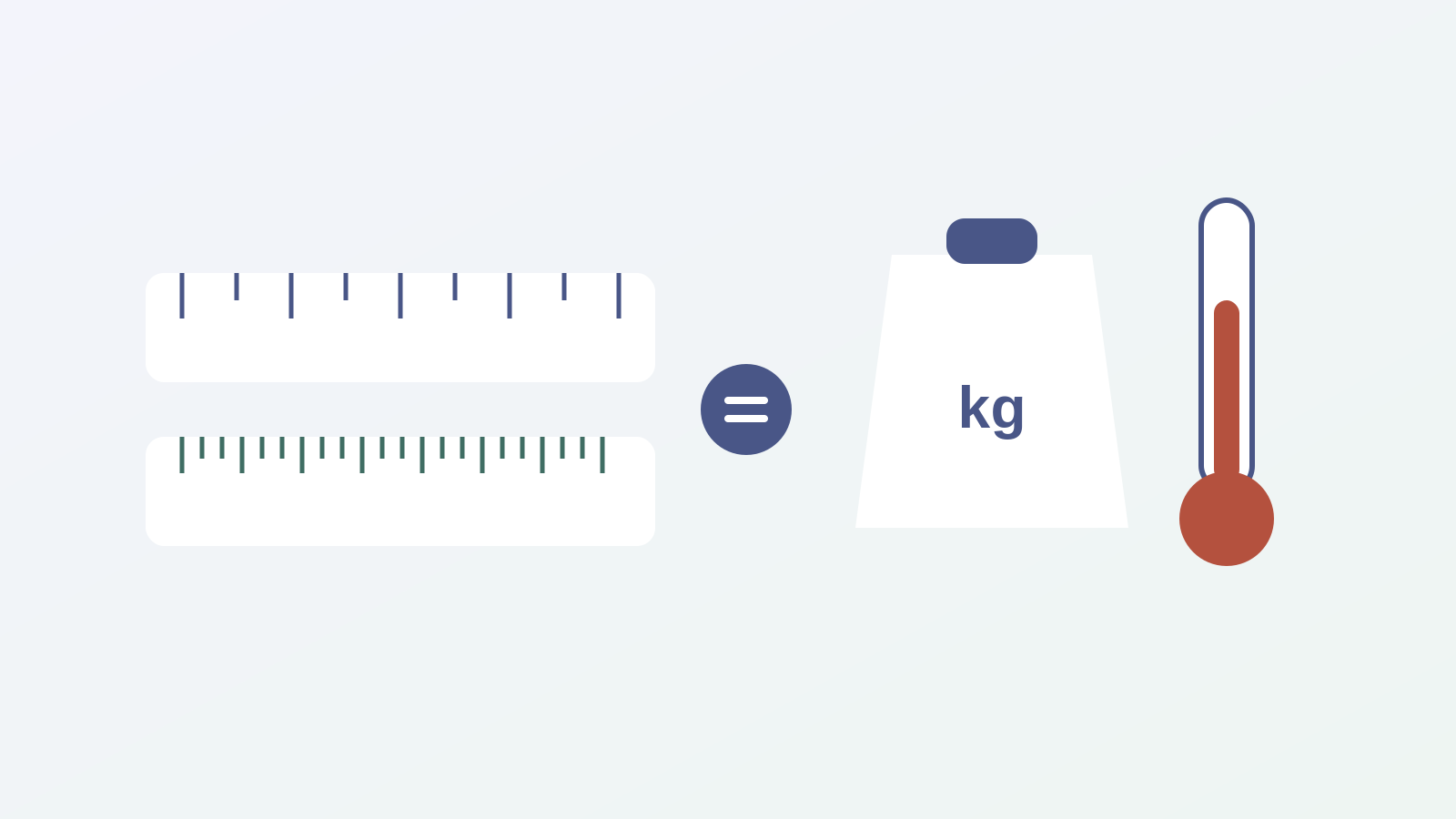
Unit conversions are everywhere: a screen size in inches, a shipment's weight in pounds, a plot of land in dunams, a temperature in Fahrenheit in a foreign forecast, and storage that doesn't match what the box says. The Unit Converter shows a value in every unit at once, but knowing the basic conversions and what's behind them protects you from costly mistakes.
Key takeaways
- 1Many conversions are exact definitions, not approximations, such as 1 inch = exactly 2.54 cm.
- 2Temperature isn't converted by multiplying alone; there's an offset because the scales start at different zeros.
- 3Storage differs between decimal and binary units, so a drive shows smaller than the box says.
- 4For important transactions, use exact values, not rounded ones.
Unit conversion: exact values worth remembering
These conversions are officially defined with exact values, not rough estimates:
Conversions defined by exact values
- 1 inch=2.54 cm
For screen and pipe sizes
- 1 foot=30.48 cm
12 inches
- 1 mile=1.609344 km
The statute mile
- 1 lb=0.45359237 kg
For shipping and product weights
- 1 dunam=1,000 m²
The metric dunam, for land areas
- 1 acre=4,046.8564224 m²
The international acre
For official values, see the NIST unit conversion page from the US National Institute of Standards and Technology, a reference for converting between metric and US customary units.
1. Length and weight: beware of rounding
Rounding that can cost you
- An inch is "about 2.5 cm"
- A pound is "half a kilo"
- A mile is "1.6 km" over long distances
Exact values that protect you
- An inch is exactly 2.54 cm
- A pound is 0.45359237 kg
- A mile is 1.609344 km
The difference is small for one item, but it grows in a large shipment, a long distance or a manufacturing order with precise dimensions.
An illustrative example: a shipment in pounds
Suppose an overseas supplier states that a shipment weighs 2,200 pounds and the carrier charges by the kilogram. With the common shortcut "a pound is half a kilo", you get 1,100 kilograms. Using the exact value, 0.45359237 kilograms per pound, the weight is about 998 kilograms. A hundred-kilogram difference can change the shipping price or have you booking more space than you need. Rounding is fine for a quick estimate, but any unit conversion that money or a contract depends on needs the exact value.
2. Temperature: an offset, not just a multiplication
Celsius and Fahrenheit don't start from the same zero, so converting needs a multiplication and then an addition:
| Conversion | Formula | Example |
|---|---|---|
| Celsius to Fahrenheit | F = (C × 9 ÷ 5) + 32 | 30 °C = 86 °F |
| Fahrenheit to Celsius | C = (F − 32) × 5 ÷ 9 | 100 °F ≈ 37.8 °C |
| Water's freezing point | 0 °C = 32 °F | At normal atmospheric pressure |
| Water's boiling point | 100 °C = 212 °F | At normal atmospheric pressure |
A quick rule for mental estimates
For a rough Fahrenheit-to-Celsius estimate, subtract 30 and halve the result. So 80°F becomes (80 − 30) ÷ 2 ≈ 25°C, against an exact value of 26.7°C. That's enough to tell whether a foreign forecast means hot or mild, but not for precise recipes or appliance settings, where you should use the full formula.
3. Why does a drive show smaller than the box?
1 TB = 1,000,000,000,000 bytes (10 to the power 12).
Many operating systems count a GiB as 1,073,741,824 bytes (2 to the power 30).
A 1 TB drive shows about 931 GiB, and no capacity has actually been lost.
You'll notice the same distinction when compressing images and video, as in our image optimisation guide.
4. Tips for mistake-free conversion
- 1Always write the unit
A number without a unit is the most common mistake in emails and quotes.
- 2Use exact values for transactions
And rounding only for casual talk.
- 3Double-check with a tool
Using the Unit Converter, which shows every unit together.
- 4Watch out for local units
Some traditional units differ between countries, so confirm the definition in use.
Always write the unit next to the number
The most dangerous unit conversion mistakes happen when a number is written on its own: "area 500" could mean square metres or square feet, a difference of roughly ten times. Make writing the unit a habit in every document, spreadsheet and message, especially when dealing with suppliers or customers from countries that use different measurement systems.
Common unit conversion mistakes
Converting area as if it were length. If a metre is 100 centimetres, a square metre isn't 100 square centimetres but 10,000. For area you square the conversion factor, and for volume you cube it.
Rounding at every step. When you convert in stages, such as feet to inches and then to centimetres, rounding at each step adds up. Keep full figures until the final result, then round once.
Confusing units with similar names. The metric tonne, the US short ton and the UK long ton are three different values, as are the ordinary ounce and the troy ounce used for gold. Check which one the context means.
Relying on memory for important calculations. For contracts, orders and technical specifications, use a reliable tool or an official table, and check the result a second time before you rely on it.
Forgetting regional units. Some measures, such as the dunam for land, vary between countries or have historic local values. When a figure matters, confirm which definition the document uses rather than assuming the one you know.
Sanity-check the result
After any conversion, ask yourself whether the number makes sense. A centimetre is smaller than an inch, so a length should have more centimetres than inches. A kilogram is heavier than a pound, so there should be fewer kilograms. This quick check catches the most common mistake of all, multiplying when you should divide, before a wrong figure reaches an invoice or an order.
Everyday examples
A 55-inch TV is measured diagonally: about 139.7 cm corner to corner, not its width. A 3-dunam plot is 3,000 m², about 0.74 acres. A 50 lb parcel is about 22.7 kg — useful when comparing international shipping prices. A recipe at 350 °F means about 177 °C. A 50 Mbps connection downloads a 500 MB file in roughly 80 seconds in theory, a little longer in practice.
Conclusion
Unit conversion is simple once you know the exact definitions: an inch is 2.54 cm, a pound is 0.45359237 kg, a metric dunam is 1,000 m², temperature uses an offset, and storage sits between decimal and binary. Always write the unit, and use exact values in transactions. For percentages use the Percentage Calculator, and to calculate BMI with the right units read our BMI guide.
Frequently asked questions
How many centimetres in an inch?
One inch is exactly 2.54 centimetres, by international definition.
How many square metres in a dunam?
The metric dunam used in the region equals 1,000 square metres.
Why does a drive show less capacity than advertised?
Manufacturers count in decimal (1 TB = 1,000,000,000,000 bytes) while many operating systems display binary units, so 1 TB shows as about 931 GiB.
How many kilometres are in a mile?
A statute mile is exactly 1.609344 kilometres, and 1.6 is close enough for everyday use. The nautical mile used in shipping and aviation is 1.852 kilometres, so check which mile is meant when you read a distance in a sea or air context.
Is a US gallon the same as a UK gallon?
No. A US gallon is about 3.785 litres and an imperial gallon about 4.546 litres. The difference is large enough to change fuel-consumption or material calculations, so check where the figure comes from before converting.
Sources & references

I believe technology is useful when it solves a clear problem — not when it's adopted because it's trendy. AI is a powerful tool for speeding up research, writing, analysis and automation, but it needs human expertise to review, guide and verify accuracy. That's why I prefer to start by understanding the business and its goals, then choose the simplest solution that delivers a measurable result, and build audience trust with honest, useful content.
- Reader rating
- 5.0(2)
- Published articles
- 82
- #unit conversion
- #metric system
- #measurements
- #converter
How would you rate this article?
Be the first to rate
Comments
No comments yet. Share your thoughts!